Human Signals
Notify Me
Coming Soon · A Practical Playbook

The gap between what you're capable of and what the world credits you for isn't a skills gap.
It's a signal gap.

Human Signals draws on the real techniques of professional mentalists — named, cited, sourced — to teach you what actually closes that gap: seeing people accurately, connecting for real, and becoming impossible to overlook.

No spam. One email the day it launches.

Human Signals — book cover

Not another book about "reading people."

Human Signals is built to be used, not just read — every idea in it is designed to be tried in a real conversation this week.

01

Not theory. A playbook.

Five practical plays per chapter, each with a real before/after example — not concepts to admire, moves to actually run.

02

Built on real mentalists, not gurus.

Drawn from the recorded interviews, performances, and public conversations of named, working mentalists — cited throughout, not invented.

03

An ethical line, every chapter.

The same skills that help you understand someone can be used to manipulate them. Every chapter draws that line explicitly.

Six verbs, in a deliberate order.

SEE accurately, and you have the raw material. CONNECT for real, and people let you closer. GUIDE attention, and they notice what matters. Get REMEMBERED, and it survives the room. ADAPT, and it survives contact with reality. ACT, and it turns into something.

CH.01
See
See What's Actually There
Everything else in this book depends on what you noticed first.
CH.02
Connect
Make It About Them
People can tell, almost immediately, whether an interaction is about them or about you.
CH.03
Guide
Guide Attention
Most people try to get attention. Learn to guide it.
CH.04
Remember
Design What Lasts
What actually happened matters less than what gets remembered afterward.
CH.05
Adapt
Stay With What's Happening
The plan is not the point. What you do when it breaks is.
CH.06
Act
Start Before You're Ready
Insight that never turns into action was never really insight.

Every play, broken down the same practical way.

A real page from Chapter 01 — SEE.

Play 01

Set the Baseline

What It Is
Noting how someone normally looks, sounds, and behaves before you try to read what a specific moment means.
Why It Works
The same gesture means different things on different people. A baseline is what turns a random observation into a meaningful deviation.
When To Use It
The first few minutes of any conversation where reading someone accurately matters — a negotiation, a difficult check-in, a first meeting.
What To Do
Spend the opening of the interaction just noticing — pace of speech, posture, energy — before you start interpreting anything.
What To Avoid
Skipping straight to interpretation. Without a baseline, you're not reading the person — you're reading your assumptions about people in general.
Without It
A single pause in someone's speech is read as a red flag on the spot.
With It
The pause is noticed against how they normally talk — and read correctly as nothing at all.
USE IT WHEN… the first few minutes of any conversation where reading someone accurately matters.

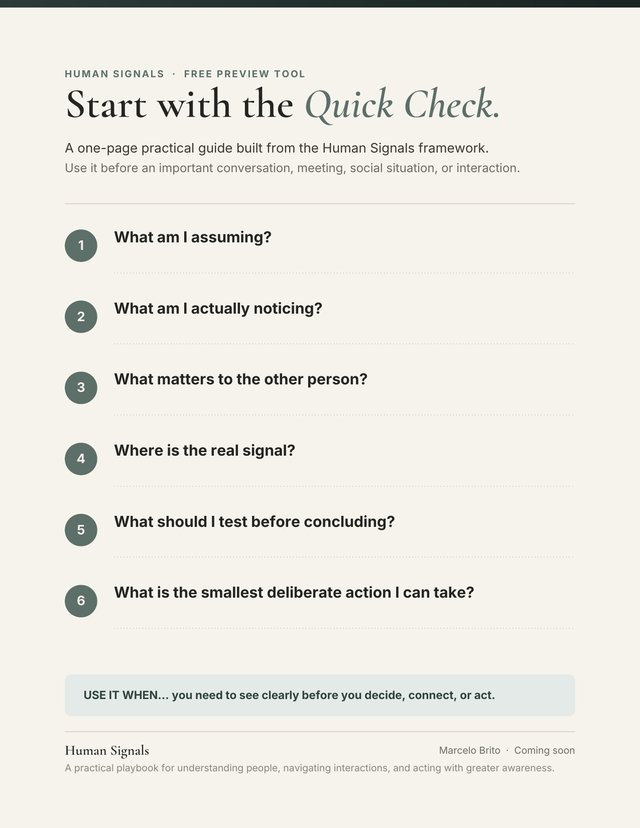
Start with the Quick Check.

A one-page practical guide built from the Human Signals framework. Use it before an important conversation, meeting, social situation, or interaction.

  • 1What am I assuming?
  • 2What am I actually noticing?
  • 3What matters to the other person?
  • 4Where is the real signal?
  • 5What should I test before concluding?
  • 6What is the smallest deliberate action I can take?
Get the Quick Check

Free. Delivered straight to your inbox.

Preview of the Quick Check one-page guide
MB

"I believe every person carries the capacity to go far beyond where they stand today… What's usually missing is the practical path to get there. That's what this book offers."

Marcelo Brito
Author, Human Signals

Be the first to know when Human Signals launches.

Join the list for the release date, an early excerpt, and nothing else.